Atomic Media Day 2026: New Beginnings, Big Ambitions and Personal Stories in Altenmarkt

Featured image: Atomic Media Day. Photo courtesy of Atomic.
At its annual gathering in Altenmarkt, Atomic brought together retiring racers, young prospects and World Cup champions for a closer look at the people preparing for the 2026–27 season.
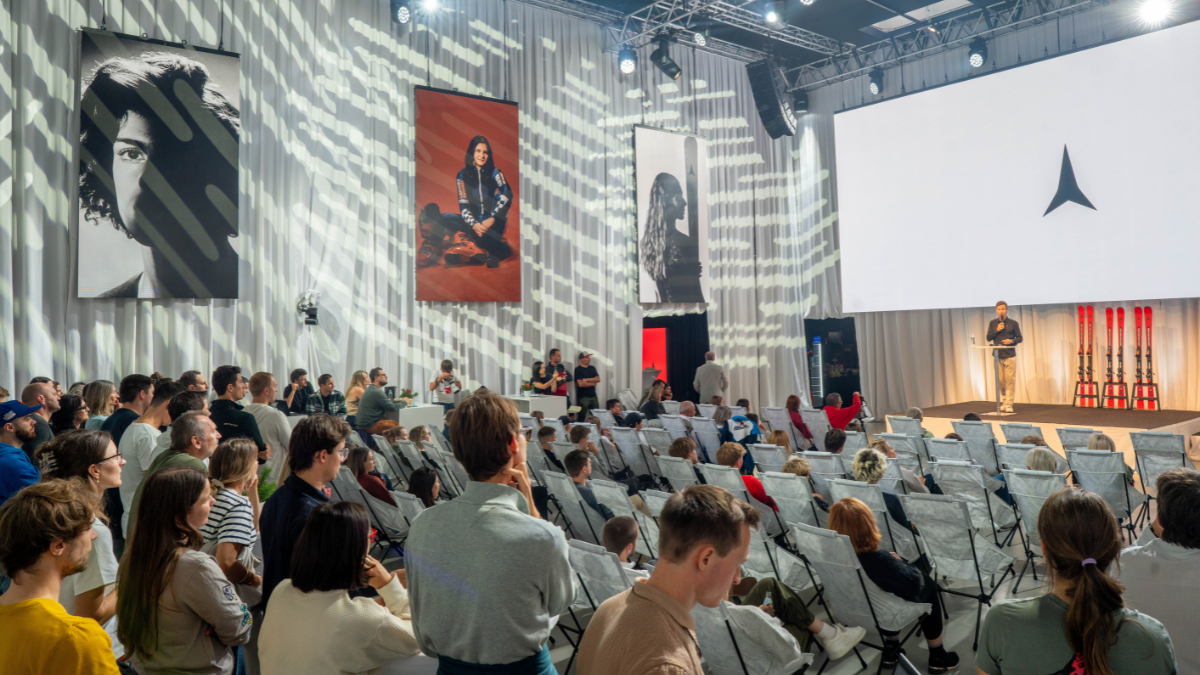
The first racers invited onto the stage at Atomic Media Day were preparing for a winter without a World Cup schedule. Mirjam Puchner, Christina Ager and Daniel Danklmaier received commemorative skis marking careers spent with the Austrian brand, while the conversation turned to what happens when racing no longer determines the calendar.
Ager had already filled some of that space with other sports, although her competitive instincts were proving harder to leave behind. Tennis, mountain biking and surfing had given her plenty to do, she explained, but accepting that she could not be equally good at everything was taking some practice. Danklmaier, meanwhile, had found a way to keep working with racers, joining Atomic’s junior development staff after stepping away from competition.
Their appearances set the tone for an afternoon that moved through several stages of a racing career. Atomic gathered its Redster athletes and international media in Altenmarkt im Pongau on Oct. 8, with the Sölden World Cup opener approaching. The program offered a chance to hear how the athletes were managing the changes that would shape their winters, from new equipment and revised race schedules to recovery plans that remained uncertain.

Returning to Altenmarkt
Bringing Media Day back to Altenmarkt placed those conversations beside the factory where Atomic’s racing skis are made. The location also connected the event to the people working behind the athletes, with employees from production, development and the company’s offices among those attending.
Atomic President Wolfgang Mayrhofer spoke about investment in the site and the company’s growth within a global ski market he described as largely flat. He credited the employees and athletes who contribute to product development, emphasizing the daily work required to keep improving. The racing department was coming off an Olympic winter that, according to Atomic, produced 20 World Cup victories, 46 podium finishes and seven Olympic medals.
Global Race Manager Christian Höflehner said the objectives for the coming season remained consistent: compete for victories and podiums across the men’s and women’s disciplines, with medals at the World Championships in Crans-Montana another major target. Getting the athletes ready had required some flexibility. Teams had made use of spring conditions in Europe, while some extended their overseas camps or returned to South America for a second trip as summer conditions changed.
That preparation explained one notable absence. Aleksander Aamodt Kilde was still in South America, where another training block took priority over attending the event. His progress would come up again later, when Mikaela Shiffrin discussed his recovery and her hopes for his return to racing.
Passing experience to the next generation
The retirement presentations gave Atomic an opportunity to explain how its relationships with athletes continue after their final races. Through its Legends program, the company maintains connections with former competitors, while Juniors to Champions focuses on the young athletes beginning their own progression through the sport.
Danklmaier’s new role brings those two parts of the program together. Working alongside Jürgen Graller, he will draw on his recent World Cup experience to support developing racers. His familiarity with the equipment and the people at Atomic is already established; the new responsibility is to help younger athletes benefit from that knowledge.
“I received the best support, and I want to pass that on to the young athletes,” Danklmaier said. Graller emphasized the importance of open communication and having someone who understands what current racers are experiencing. Having recently left the World Cup, Danklmaier brings a perspective that can help connect the company’s technical expertise with the needs of its juniors.
Two young Austrian racers then joined them on stage and received limited-edition racing suits in recognition of their results. Their answers included a conversation with Shiffrin earlier in the day and admiration for Lucas Pinheiro Braathen. Their answers brought the development discussion back to the athletes themselves and the opportunity to spend an afternoon around racers they usually watch competing.
Finding confidence on new equipment
Franziska Gritsch was introduced as a new member of Atomic’s World Cup team, and her description of the equipment change was grounded in how it felt to ski again. Training in Sölden and Obergurgl during the spring had given her an early opportunity to work with the new setup. After several difficult seasons, she said she was finding the feeling she wanted in her turns.
“I feel very comfortable. It’s fun again. I can feel my turns the way I want to,” Gritsch said. There was still technical work to do, but she spoke positively about the transition and the support around her.
She was also careful about what that meant for the first races. Her starting position would make an immediate return to the podium difficult, and she wanted expectations to reflect where she was beginning. Gritsch described a step-by-step approach, comparing the temptation to rush her progress with skipping stairs and risking another fall. The ambition to race at the front remained, but she wanted to establish that progress through her skiing.
Switzerland’s Malorie Blanc was also getting to know a new service technician. She had first worked around him in Chile the previous year and had more time with him during this summer’s camp. Alongside the technical relationship, she stressed the importance of getting along as people, adding that his appreciation of red wine had at least made choosing a gift straightforward.
Blanc’s larger target was close to home. She recalled the emotion of her first World Cup victory in Crans-Montana, where family, friends and supporters from her region had shared the occasion. The prospect of returning for a World Championships had been part of conversations throughout the summer, although she was quick to point out that qualifying came first.
Tanguy Nef shared that connection to the region, having learned to ski in Valais. He spoke about carrying confidence from the previous winter into summer training, while also making time to get away from skiing. Surfing and foiling in New Zealand provided that balance, something he had learned to value as his career progressed. The training itself had encouraged him too: he felt he had returned at a level comparable to where he finished the previous season.

Recovery sets the timetable
When the Italian athletes took the stage, Sofia Goggia described a preparation period interrupted by illness. She had returned early from Ushuaia after developing neurological symptoms, and said examinations during two weeks in hospital identified chikungunya and parvovirus B19 infections.
Goggia described shaking, difficulty managing stairs and periods when coordinating her movements or organizing her thoughts had become difficult. By Media Day, she was feeling better and had resumed some gym work, but fatigue and lingering symptoms were still affecting what she could do. She hoped to try a short period of gentle free skiing to assess her balance, without setting a firm racing target.
Her account made clear why the return would be gradual. Feeling well enough for one session did not yet mean being ready for a full training program, and she was assessing her progress day by day. The conversation also made room for an achievement away from racing: Goggia had completed her bachelor’s degree in political science alongside her sporting career.
Nicol Delago, who appeared with Goggia and Alex Vinatzer, was looking back on her first World Cup win. She said she still enjoyed watching the footage because the day itself had moved too quickly to absorb everything. Reviewing it later brought the emotions back and gave her time to appreciate a result that had followed years of work and injuries. Her aim now was to carry that progress into another season.
Manuel Feller’s return also depended on how his body responded. He described himself as approximately 98 percent pain-free in everyday life and said he was able to do more in training each week. His first days back on snow had gone well, but free skiing was only the first test before rebuilding toward race demands.
Feller spoke openly about the frustration of working hard through rehabilitation while continuing to experience pain. Recent progress had helped restore his motivation, although he would not commit to a return date simply to have one on the calendar. Levi, Gurgl and Val d’Isère were possibilities, depending on his health and form. “I’m not putting any pressure on myself anymore,” he said, with slalom remaining his priority and giant slalom largely behind him.

A different direction for Schwarz
Marco Schwarz had made a more definite decision about his schedule, stepping away from slalom to concentrate on giant slalom and the speed disciplines. It had taken months to reach that point, he explained, given how much of his career and success had been tied to slalom. Since his last injury, however, the familiar feeling on the shorter skis had not returned as he wanted.
“I feel very comfortable on the long skis. I sense that there’s much more potential if I concentrate on that,” Schwarz said. Focusing his preparation would give him more time in the disciplines where he now felt he could make progress, with giant slalom and super-G central to the program and selected downhills also possible.
The changes extended to his service team. After eight years with Kim Erlandsson, Schwarz was building a working relationship with a new technician following Erlandsson’s move into a testing role. He said the transition had encouraged him to become more involved in equipment discussions again, while acknowledging that the trust developed over eight seasons could not be recreated immediately.
Raphael Haaser, alongside him on stage, offered a view of what can follow an equipment transition. He described his first season with Atomic as his most consistent and said a productive summer had left him hoping for another step forward. With their programs now more closely aligned, both racers saw value in spending more time training and travelling together. Fabio Gstrein also reported a productive preparation block, describing roughly 20 days in Chile after plans to remain in Europe had changed.
Perspective after a difficult season
Zrinka Ljutić and Lucas Pinheiro Braathen shared one of the day’s more personal exchanges. Asked about a difficult winter following her breakthrough, Ljutić took time to explain what the experience had meant. She briefly joked about answering in Croatian when finding the right words in German became difficult, then returned to the importance of having gone through a season that had challenged her.
“Things don’t only go uphill. Looking back now, I’m grateful for it, and I wouldn’t change anything,” she said. Her summer had included her first training trip to New Zealand, music and time working alongside Braathen in Salzburg. The two had also talked about the expectations that follow early success and the difficulty of learning to manage attention while still developing as an athlete.
Pinheiro Braathen recognized parts of his own experience in that conversation. He spoke about the challenges he had faced and the value he could now see in decisions that had been difficult at the time. Representing Brazil had taken him into a different environment, and his Olympic success had changed the way people there understood his sport.
In Rio de Janeiro, where he trained alongside athletes from other sports, he found himself being approached by people who knew what ski racing was. He also described seeing skiing become part of the country’s Carnival celebrations, with skiers appearing on the beach. “Hopefully, the Brazilian dream is a little bigger today,” he said, reflecting on what that recognition meant to him.
Shiffrin leaves room to explore
Shiffrin closed the athlete presentations with questions about her recently announced approach to the season. Before discussing the schedule, she gave her physical preparation an eight out of ten, explaining that she would never give anything a ten. Her skiing received a six, with room to improve after snowstorms had complicated parts of two training camps in Chile.
She credited her coaches and service team for managing the logistics, while acknowledging that she would have liked more productive days before Sölden. Her revised calendar is intended to create the time and energy to work more deeply on giant slalom and some super-G, including equipment choices she had not previously had enough space to explore.
“I feel like I can find out what’s possible,” Shiffrin said. Boot setup was one area under consideration, and changes within her support team were part of the adjustment as well. Her mother would travel less than in previous seasons, and a new physical therapist had joined the group. Shiffrin said the team was working well together and that she felt optimistic about the changes.
She was careful to explain that choosing a different balance of disciplines did not make the task easier. The women racing against her were fast and working hard, and she wanted to give herself a proper chance to understand what she could achieve. Slalom would remain part of her season, with the rest of the schedule allowing flexibility as she learned more.
Before leaving the stage, Shiffrin returned to Kilde, who was still training in South America. She described how much more comfortable he had become in his body compared with the same point a year earlier, while continuing to adapt to the lasting limitations of his shoulder injury. Watching that progress had impressed her, and she was looking forward to seeing him race again.
Shiffrin asked those watching to wish him luck as he continued that work. She wanted him to have the opportunity to enjoy ski racing again, and said she was looking forward to watching the beginning of his season as much as everyone else.

Quotes from German-language portions of the event have been translated into English. Photos: Atomic.
About the Author: Darka Sefcik Starnova

Related Post