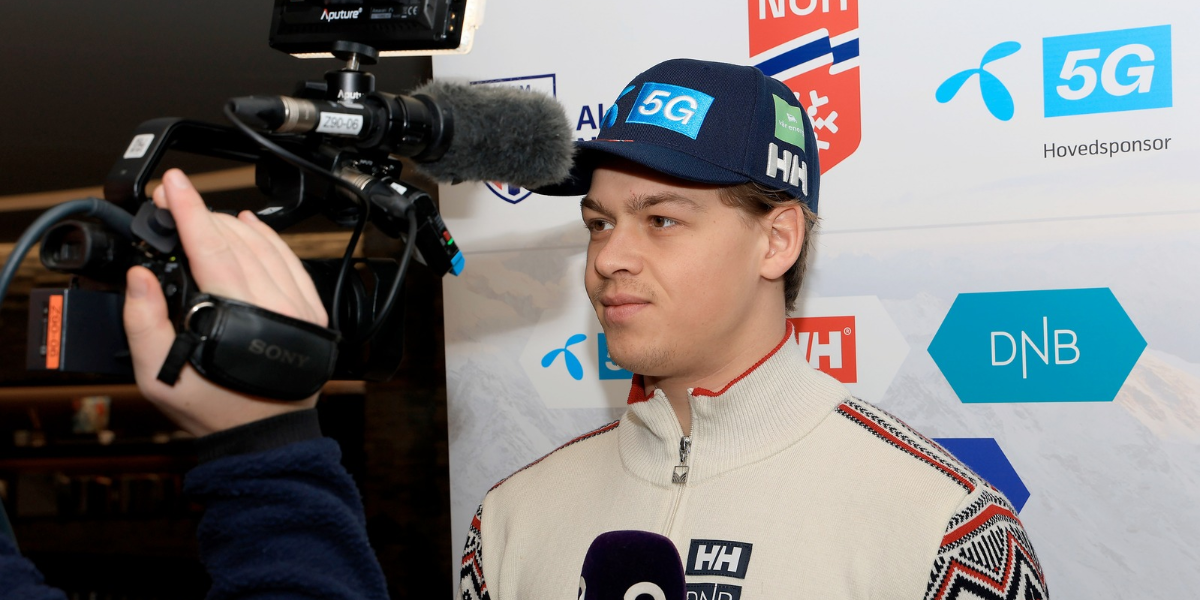
Alexander Steen Olsen to Make World Cup Comeback in Sölden

Alexander Steen Olsen / GEPA pictures
Alexander Steen Olsen, the 2024 Sölden winner, returns to World Cup racing on the Rettenbach Glacier this Sunday. Last December, he made the difficult decision to undergo surgery and miss the entire Olympic season.
In an interview with Ski Racing Media last week, Steen Olsen described the difficulties that made surgery for his debilitating jumper’s knee inevitable, how he managed the emotions after surgery, and the need to adjust to a new mindset and training style on his way back to World Cup racing.
Steen Olsen’s Early Success
Steen Olsen made rapid strides in World Cup racing at a young age.
He started his first World Cup race in February 2021 at age 19 and entered occasional World Cup races for the next two seasons.
Then, in 2022, he won both the giant slalom and slalom FIS Junior World Ski Champion titles, before finishing 10th in giant slalom and 16th in slalom at the World Cup Finals a few days later.
From then on, the youngster from Oslo, Norway, began climbing both the World Cup Starting List and the result pages.
Impressively, the then-21-year-old captured his first World Cup victory during his first full World Cup season in 2022-23 at the Palisades Tahoe slalom. He finished ninth in the World Cup slalom standings the same year.
In October 2023, Steen Olsen spoke with Ski Racing Media about his rapid rise and his diverse, solid training background as a young athlete.
In his second and third full World Cup seasons, he finished sixth and fourth, respectively, in the giant slalom World Cup standings and captured two more World Cup wins in 2025.
At the same time, his knee problems worsened.

The Jumper’s Knee Injury Taking Over
“I’ve had this injury for six or seven years, and it’s been gradually getting worse. For the first four to five years, it was mostly just painful.
“Two years ago, it started to get worse and I could get these acute incidents. It would take quite a long time for it to calm down, at least a couple of weeks without skiing or doing anything high-intensity,” Steen Olsen explained to Ski Racing Media last week about past knee troubles.
When the 2025 season ended, he took a long break from skiing to focus on rehabilitation before the Olympic season.
Still, when returning to preseason skiing with the Norwegian team last fall, the knee problems persisted despite the previous months of tedious rehabilitation efforts.
He felt disappointed and frustrated.
Preparing for the 2025 Sölden opener, Steen Olsen followed an easier training program to stay within the limits of what his knee could handle.
“But from the get-go I really struggled. I wasn’t able to get into positions that I wanted to and that I knew I had to get into to ski fast,” he explained.
“When the race got closer and we had trainings on the race hill, I was still not able to ski properly,” he explained about Sölden last year.
The outcome was bitter: Steen Olsen had to travel home instead of starting in the Sölden World Cup opener he had won the year before.
Steen Olsen Thinks Long Term
A difficult decision lay ahead of him late last fall: one that could mean missing the Olympic season.
The period while weighing his options was mentally challenging.
“It was a really hard time because I wasn’t injured [in a way that] I couldn’t stand and couldn’t keep fighting to try and race.
“I had reached a point where I either had to [just] ski races, hope that I could survive two runs and achieve some kind of results, or I could do surgery and think long term – which I concluded was the best for me,” Steen Olsen said.
His age played into his decision.
“If I was 30 years old or close to the end of my career, I would never throw away an Olympic season if I didn’t have to. Then, the focus would be to try and perform on that single day.
“But since I hopefully have many more years of racing, I didn’t want to exchange one medal for hopefully many opportunities to achieve different things,” the 25-year-old explained.
A Difficult Recovery
Even though Steen Olsen believes surgery was the right choice, he said the recovery brought difficult thoughts about whether he could return to his former level. For now, he is focused on getting healthy enough to train and trust his body at the start.
“You get these thoughts that, ‘Is this how far I was able to make it? Am I able to get back to the level that I was?’”
Steen Olsen does not doubt he can get back to that same level if he becomes completely healthy.
“But the challenge is that I’m not 100 percent healthy. So, this season, I just hope I can get back to a point where I’m able to do at least some amount of training and to be able to feel that I can be on start and trust my body, that it won’t collapse, kind of. And that I at least feel somewhat prepared.”
“For a long time after the surgery I had taken a big step back. That’s just how it is and that was expected,” Steen Olsen said.
After a while, he started to notice progress in the gym and, slowly, he has built upon that.
But skiing is demanding on an entirely different level.
“For me, to start skiing a lot now is not possible. I have to give myself time; ease into it and let my body get used to that type of load again.”
However, he felt some improvement while at the Norwegian team’s camp in Schnalstal, Italy, last week:
“Now, back skiing, I would say at least compared to last year, it’s been an improvement. But still, I have my challenges and not every day is easy.”
Sliding Down the Longest Chute
Ten days before this year’s Sölden start, Steen Olsen compared his situation with playing the board game Chutes and Ladders:
“You are making very good progress, you are maybe falling down some small chutes and have to make some small steps back, and then you make progress.
“At this point, I’ve probably hit one of the longest downward chutes in my career.”
He has reached the point where he chooses to accept the situation and work on progress. However, he needs to adjust his mindset when returning to racing:
“Once you’ve been top 10, you are not satisfied with being top 20. So, of course, now I need to adjust and set my expectations right and be happy to make those small progressions even though I have been at a much higher level before.”
Getting Through a Difficult Winter
Missing the 2026 race season was not easy.
“I did what I felt was the right thing, but I still struggled to make peace with the decision,” Steen Olsen explained.
The periods before and after the surgery differed:
“I was kind of more frustrated and angry when I were considering doing surgery.
“And then I was depressed after the surgery even though I felt like it was the right choice. But I was in a situation that I really didn’t know how to handle.”
He added:
“After the surgery, I was ok with being sad and you could say depressed. I knew it was a part of my recovery. I told myself, ‘It’s ok to feel like this for a while, I just have to give it time,’ and I didn’t really try to fight it.”
Finding His Way Back to Skiing
For a while after the surgery, Steen Olsen needed to create distance to ski racing.
When the late-January Kitzbühel World Cup weekend came around, he decided to finally watch ski racing on TV, even though he did not feel like it.
He told himself:
“‘Ok, now I can’t feel sorry for myself anymore. Now I have given myself time.’
“It wasn’t easy, but eventually I had no problems watching races,” he said.
As time moved on and he experienced progress in the gym, Steen Olsen started to feel the urge and motivation to ski again.
In late April, he could put his skis back on during a Norwegian team camp at Kvitfjell. While the experience was positive in many ways, the return to snow also clearly demonstrated the status at the time:
“I saw the other guys pushing in training and skiing in courses, trying to get better. I just had my first days kind of slipping around.”

Learning a New Mindset
Did he learn something from the process?
“I learned a lot and keep learning a lot about how to handle the situation I’m in and not being able to do exactly what I want all the time,” Steen Olsen replied.
“Earlier in my career, I was a racer that really enjoyed training a lot and to keep skiing to figure out how I could, for example, learn to ski in tracks or types of conditions or course sets I struggled with. I used the repetition to learn it.
“I’m not in that position anymore that I can use training in that way to get better. I have to really focus on the little I can do and make the best out of that. I have to learn a new mindset, in a way,” he explained.
He worked on accepting and increasing his understanding of the new training situation during the Norwegian ski camps in New Zealand and Schnalstal this preseason.
The new reality requires finding the right balance:
“The challenge now is to figure out where I am. I don’t want to push so hard that I get this amount of pain so that I am not able to ski. I really have to find a balance for training and not push too hard, because I know I’m vulnerable,” he told Ski Racing Media 10 days before the Sölden opening race.
Learning From His Teammates
Steen Olsen has found help in talking with and learning from his teammates.
“I have talked with Aleks [Aamodt Kilde] about these mental challenges, and I know he has a lot of mental experiences from being injured. He’s had one of the biggest comebacks there is.”
Steen Olsen also pointed out similarities with Lie McGrath’s injury history, as he too handled long injury breaks early in his career.
“So, I know I don’t have to figure out all the steps myself coming back from an injury, even though my injury is different than Atle or Aleks or whoever it might be,” Steen Olsen said.
“There are a lot of the same processes going on and therefore it is very smart to use the experience that they have been through.”
The Norwegian team has a mentality and culture of talking together.
“That’s the reason we are a very proud team. It’s not just that we are training together. It is also that we are helping each other in all the ways we can and I think that is extremely positive in every way,” he pointed out.
Close Cooperation With His Ski Technician
Steen Olsen also has a close work relationship with his ski technician, Lojze Debelak from Slovenia. According to Steen Olsen, they have worked together since the 2022-23 preseason.
“He has always been extremely positive and since I can be quite tough on myself, I am happy that I have him,” Steen Olsen said.
Debelak holds decades of experience working with athletes and preparing skis. That experience is important to Steen Olsen now.
“In the situation I am in, coming back from injury, he knows my preferences. Right now, I don’t have to take a big part in the equipment discussion. I trust him so much and he knows me, so I can let him deal with that, which is extremely important for me now. I can focus on myself and the skiing.
“He is always calm and positive. I’m extremely happy, lucky and grateful that I have him,” Steen Olsen said about the ski technician.

Looking Forward to Racing Again
Now, the time has come to put the race bib back on.
“I’m looking forward to getting back into racing. I know it will probably be tough, and it will probably be hard for me to set the expectations at the right level. I don’t want to make the challenges too easy to overcome, but I also don’t want to be unrealistic,” Steen Olsen reflected last week.
About the race start in Sölden, he said:
“You are not prepared for a World Cup race at this point. You would of course like to have more training. But that’s always how everybody feels. So, it’s just to accept that it’s an uncomfortable situation to be in.
“I think everyone with ambitions thinks it’s a pretty exhausting day.”
Still, his first day back at a World Cup start feels special to Steen Olsen:
“After knowing how it’s not being able to compete, I will for sure try to enjoy being back on the start line.”
About the Author: Bente Bjørnsen Sherlock
Related Post